
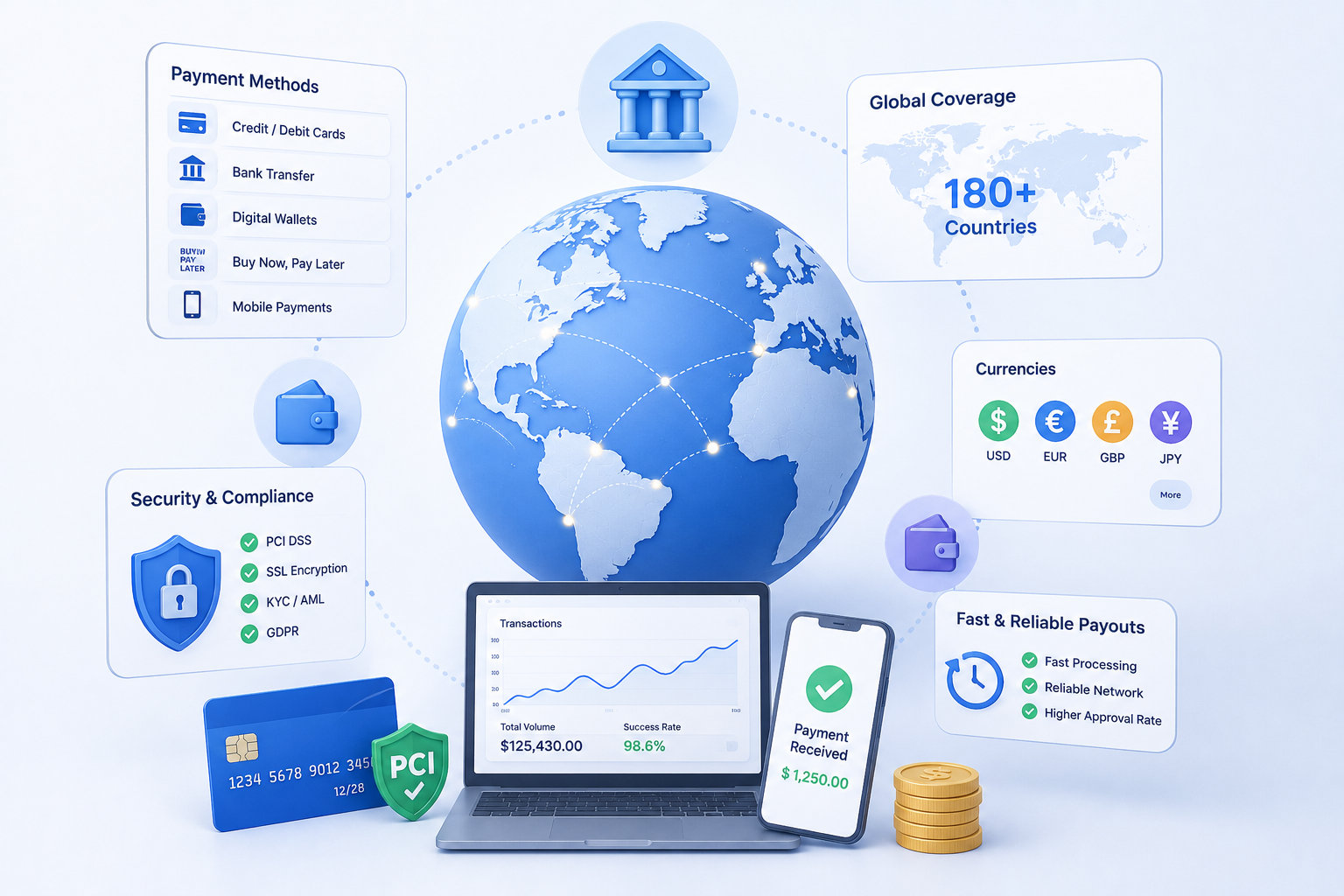
Discover how to accept international payments from 180+ countries. Businesses selling across borders face a fundamental challenge: getting paid reliably from customers in dozens of countries, each with different currencies, banking systems, and payment preferences. This guide walks through everything you need to accept international payments in 2026 — from the technical setup to compliance requirements.
What Does It Mean to Accept International Payments?
Accepting international payments means receiving funds from customers whose bank accounts are located outside your home country. This goes beyond simple credit card processing — it involves multiple currencies, cross-border banking networks, local payment preferences, and regulatory compliance in both your home jurisdiction and your customer's.
For a business expanding internationally, the difference between offering local payment methods and only accepting cards can mean the difference between a completed purchase and an abandoned cart. Studies show that providing locally preferred payment methods can increase conversion rates by 20–40% in cross-border transactions.
What Are the Main Methods for Accepting International Payments?
There are four primary ways to receive cross-border payments, each with distinct cost structures and settlement timelines:
1. International Wire Transfers (SWIFT)
Traditional bank-to-bank transfers through the SWIFT network. Funds move between correspondent banks, which adds fees at each step. Settlement typically takes 2–5 business days. Best for high-value B2B transactions where bank-level verification matters.
2. Cross-Border Card Processing
Accepting Visa, Mastercard, and UnionPay on your website through a payment processor. Customers pay in their local currency; you receive settlement in your home currency (minus conversion fees). Convenient but carries cross-border interchange fees of 1–2% on top of domestic rates.
3. Payment Orchestration Platforms
Advanced routing systems that intelligently route each transaction through the optimal processor based on currency, card type, geography, and acceptance rates. These platforms aggregate multiple acquiring banks and processors into a single API, maximizing approval rates while minimizing per-transaction costs. Cross-border businesses with over $500K annual volume typically see 20–35% cost savings vs. a single processor.
4. Multi-Currency Global Accounts
Holding bank accounts in multiple countries or currencies — often through a licensed fintech provider — lets you receive payments locally and settle in your preferred currency on your own schedule. This avoids forced conversion at unfavorable rates. Popular for businesses with predictable regional revenue streams.
What Factors Should You Consider When Accepting International Payments?
Choosing the right approach depends on weighing several interrelated factors:
Transaction Fees
Cross-border fees are layered: acquiring bank fees, scheme fees (Visa/Mastercard), processor markup, and currency conversion spread. A card payment that appears to cost 2.5% may actually cost 3.8% after all layers are included. Payment orchestration platforms can reduce this by routing through the acquiring bank with the lowest effective rate for each transaction's geography.
Settlement Speed
Standard cross-border settlement ranges from 2–7 business days depending on method and corridor. If you need faster access to funds, some payment providers offer accelerated settlement for a premium. For businesses with tight working capital, cross-border settlement delays can create meaningful cash flow gaps.
Currency Risk
When you receive payments in foreign currencies, exchange rate fluctuations directly affect your actual revenue. A payment received today at $1.08/€1 might be worth only $1.02/€1 by the time you convert it 5 days later. Multi-currency accounts let you hold foreign currency and convert at chosen moments, giving you more control over timing.
Acceptance Rates by Geography
Not all card types are equally accepted everywhere. In Latin America, local card schemes like ELO (Brazil) or Presto (Venezuela) dominate over Visa/Mastercard. In China, UnionPay is essential. In Southeast Asia, domestic schemes like BCA (Indonesia) or PromptPay (Thailand) handle significant volume that never touches international card networks. Payment orchestration helps by routing around unavailable payment types.
Regulatory Compliance
Accepting payments from certain countries may subject you to additional compliance obligations. OFAC sanctions screening is mandatory for US-connected businesses. EU businesses must consider PSD2 strong customer authentication requirements. High-risk categories (gaming, adult, CBD) face additional restrictions regardless of geography. Know your risk category before choosing a payment partner.
How Do Payment Methods Compare for International Transactions?
| Method | Typical Fee | Settlement | Best For |
|---|---|---|---|
| SWIFT Wire | $15–50 flat + correspondent fees | 2–5 business days | B2B, high-value transactions |
| Cross-Border Cards | 2.5–4.5% total | 2–3 business days | Retail, digital goods, subscriptions |
| Payment Orchestration | 2.0–3.2% (optimized) | 1–3 business days | High-volume cross-border businesses |
| Multi-Currency Account | 0.5–1.5% conversion + holding fee | Same-day to 1 day (local payout) | Businesses with regional revenue concentration |
What Are the Compliance Requirements for Cross-Border Payments?
Before accepting international payments, you need to address several compliance layers:
KYC (Know Your Customer): Payment processors and banks are required to verify your business identity before providing cross-border payment services. This typically includes certificate of incorporation, proof of address, director ID, and a business description. For sole proprietors or smaller businesses, requirements vary by provider.
AML Screening: Anti-money laundering regulations require that incoming payments are screened against sanctioned parties lists (OFAC, EU, UN). If your business operates in higher-risk corridors, expect additional documentation requirements and potentially elevated fees.
PSD2 / Strong Customer Authentication (SCA): Businesses accepting payments from EU customers must implement SCA (two-factor authentication) for online card payments under PSD2 regulations. This applies even if your business is located outside the EU, if you're serving EU customers.
PCI DSS: If you handle, process, or store card data, you must maintain PCI DSS compliance. For most businesses, using a hosted payment page (where the card data never touches your servers) is the simplest path to compliance. Tokenization and end-to-end encryption are mandatory for businesses handling raw card data.
What Mistakes Do Businesses Make When Accepting International Payments?
Accepting only cards: Many businesses optimize for card acceptance and neglect local payment methods. In many markets, especially Southeast Asia and Latin America, 30–60% of potential customers abandon transactions that require an international card. Offering local payment methods (e-wallets, bank transfers, local cards) directly improves conversion rates.
Ignoring the real total cost: A processor advertising 2.5% may layer on currency conversion (often 2–3%), scheme fees ($0.10–0.30 per transaction), and cross-border fees (0.5–1%). Always request a full fee breakdown including all components before signing up.
Forcing immediate conversion: Receiving a USD payment and instantly converting to EUR at whatever rate your bank offers is almost always worse than holding the foreign currency and converting when rates are favorable. If you receive predictable flows from a specific country, a multi-currency account lets you convert on your own schedule.
Not monitoring approval rates by market: Your overall approval rate might be 95%, but in specific countries it could be 75%. Without granular reporting by geography, you won't know which markets are silently failing. Payment orchestration platforms provide this level of detail.
How to Set Up International Payment Acceptance: Step by Step
Step 1: Define your target markets. Which countries generate the most demand for your product? Focus on those first. Accepting global payments from day one adds unnecessary complexity. Start with 3–5 primary markets and expand once your setup is proven.
Step 2: Choose your payment structure. For most e-commerce businesses, a combination of card processing with a processor experienced in cross-border transactions (Stripe, Adyen) plus a payment orchestration layer for optimization is the recommended approach. For B2B businesses, SWIFT capability is essential alongside card acceptance.
Step 3: Implement local payment methods for key markets. Research the top 3 local payment methods in each of your target markets. In Indonesia, GoPay and OVO matter. In Brazil, Boleto Bancário and PIX. In Germany, Klarna and SEPA direct debit. Your payment orchestration provider may offer these through a single API.
Step 4: Set up currency management. Open multi-currency accounts in your top 3–5 revenue-generating currencies. This lets you receive locally, hold strategically, and convert on your own terms rather than paying your bank's arbitrary conversion rate.
Step 5: Implement compliance controls. Ensure your payment setup includes automated sanctions screening, KYC verification for your business, and PCI DSS compliance through hosted fields or a tokenization vault.
Step 6: Monitor performance by market. Set up reporting that shows approval rates, transaction fees, and conversion rates segmented by country. Review monthly and optimize your routing and payment method mix.
Frequently Asked Questions
What is the cheapest way to accept international payments?
For businesses with sufficient transaction volume, payment orchestration platforms typically offer the lowest effective cost by routing each transaction through the optimal acquiring bank. For lower volumes, a multi-currency account with manual conversion on favorable rate days is more cost-effective than forced immediate conversion. SWIFT wires carry high fixed fees but may be the only option for B2B high-value transactions.
How long does an international payment take to clear?
Standard cross-border card payments clear in 2–3 business days. SWIFT wires typically take 2–5 business days due to correspondent bank processing. Local bank transfers (SEPA, ACH, domestic wire) within the same region clear faster — SEPA payments settle same-day. Some payment orchestration platforms offer accelerated settlement for premium pricing.
Do I need a business license to accept international payments?
Generally, yes — your payment processor or bank will require proof of business registration (certificate of incorporation, equivalent documents) before enabling cross-border payment acceptance. If your business is in a regulated industry (gambling, crypto, adult), additional licensing may be required depending on your target markets.
What currencies should I accept as an international business?
You don't need to accept all currencies. The practical approach is to accept the currencies of your primary revenue-generating markets through your payment processor (automatically converted to your home currency), and additionally hold multi-currency accounts in the top 3 currencies where you have consistent volume. Accepting local currencies improves conversion rates — customers prefer seeing prices in their home currency.
What is the difference between cross-border payment processing and a global acquiring bank?
A payment processor (Stripe, Adyen) handles the technical transaction routing. A global acquiring bank holds the merchant account and the actual relationship with the card networks. A payment orchestration platform sits on top of both, optimizing routing decisions. For most businesses, working with a single payment processor with built-in global acquiring is simpler than managing multiple acquiring relationships directly.
How do I reduce failed transactions from international customers?
Failed cross-border transactions typically stem from three causes: (1) the customer's card not being enabled for international use — customers should contact their bank; (2) 3D Secure authentication failures — implementing risk-based authentication rather than forcing step-up for every transaction reduces friction; (3) currency conversion failures — offering prices in the customer's local currency reduces validation errors at checkout.
Is it legal to accept payments from customers in any country?
Generally yes for most countries and industries, with exceptions for sanctioned jurisdictions (OFAC list, EU sanctions). Some industries face additional restrictions — online gambling, certain CBD products, and adult content face payment network restrictions regardless of country. Verify your industry's specific restrictions for your target markets before setting up payment acceptance.
Conclusion
Accepting international payments is a multi-layered challenge that goes far beyond plugging in a payment form. The businesses that scale cross-border revenue most effectively invest in understanding local payment preferences, optimize their cost structure through smart routing, and maintain compliance as they expand into new markets.
Cross-border payment infrastructure for global businesses is complex, but the right platform simplifies it. Wondergate's payment infrastructure unifies global acquiring, multi-currency wallet management, and virtual card issuing into a single API — giving cross-border businesses one partner for the full stack of international payment acceptance, instead of managing separate relationships with processors, acquiring banks, and currency providers.