
The call that starts this article
A finance director at a Singapore trading company called me on a Tuesday because EUR 412,000 had disappeared from her dashboard. It had not been stolen. It had not been frozen by a regulator. The payment provider she used had changed its European banking partner over the weekend, and the new safeguarding account was not yet reconciled, so the balance simply stopped updating. The money was there. Her ability to prove it, move it, or explain it to her board was not.
That is the part of the EMI-versus-bank-versus-PSP conversation most vendor comparisons skip. They compare fees, currencies, API quality and onboarding speed — all of which matter — but they rarely answer the only question a treasurer actually cares about at 2am: whose balance sheet is my money sitting on, and what happens to me if that balance sheet fails?
Three licences, three different balance sheets
The labels get used interchangeably in sales calls. Operationally they describe three completely different legal structures.
A bank takes your deposit onto its own balance sheet. It lends that money out. In exchange, you get deposit insurance up to a jurisdictional limit, access to central bank money for settlement, and a regulator whose resolution regime is designed around depositors. When a bank fails, there is a playbook, however imperfect.
An EMI (electronic money institution) cannot lend your money out. Under rules like the EU's EMD2 or the UK's Electronic Money Regulations, customer funds must be safeguarded — held in a segregated account at a credit institution, or covered by an insurance policy — so that if the EMI fails, the money is available to creditors. Safeguarding is not deposit insurance. It protects you against the EMI's insolvency, not against the bank where the safeguarded funds sit, and it does not guarantee same-day access during an administration.
A PSP is the loosest label of the three. Some PSPs are licensed EMIs. Some are payment institutions. Some are pure technology companies that sit in front of a bank or acquirer and never touch the funds at all. When a salesperson says "PSP", the correct follow-up is: licensed as what, by whom, and where do settled funds rest?
| Model | Who holds settled funds | Protection if the provider fails | What you can ask for |
|---|---|---|---|
| Bank | The bank, on its own balance sheet | Deposit insurance up to the local limit; resolution regime | Deposit guarantee coverage, account-level statements, credit lines |
| EMI | A segregated safeguarding account at a partner bank | Safeguarded creditor claim; no deposit insurance in most jurisdictions | Safeguarding confirmation letters, partner bank name, reconciliation frequency |
| PI / PSP (licensed) | Usually a safeguarding account, sometimes a client-money account | Client-money rules; depends on licence passporting | Licence number, permitted activities, safeguarding method |
| Technical PSP | Its underlying bank or acquirer | Whatever the underlying institution offers — and no more | The name of the institution in the flow, and the contract chain |
The balance you see is not the balance that exists
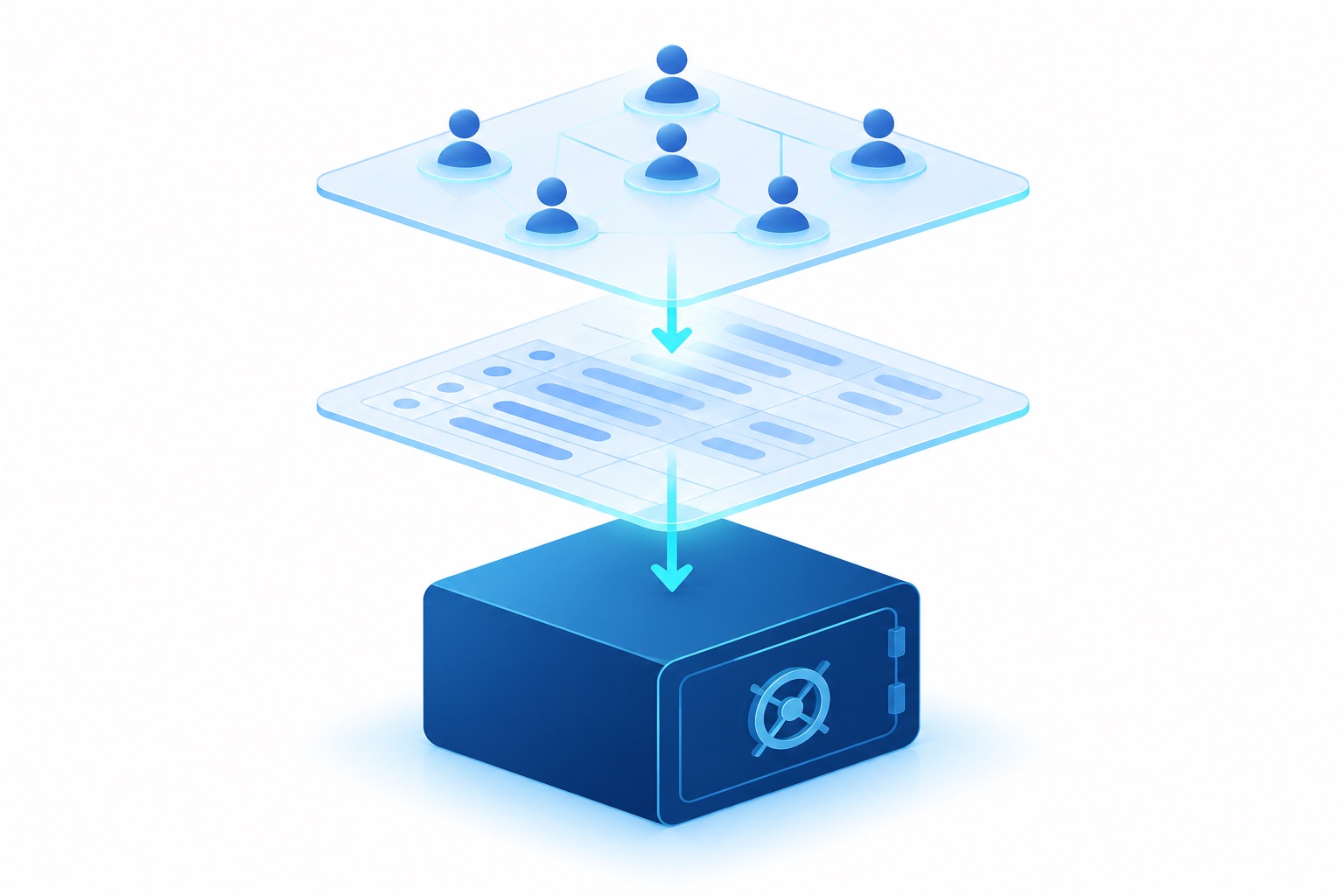
Most B2B payment problems are not solvency problems. They are evidence problems. Your dashboard shows an available balance that is derived from the provider's internal ledger. The actual money sits in one or more bank accounts, often pooled, and is reconciled against that ledger on a schedule.
Three things follow from this, and each one has bitten a finance team I have worked with:
- Omnibus versus segregated. Some providers pool client funds in one account and track ownership in their ledger. That is legal in several jurisdictions, but it means your claim is a book entry, not a named account. Ask which structure applies to you, in writing.
- Timing gaps. Incoming wires may be credited the same day in the ledger but settle T+1 at the bank. Outgoing payments may leave your balance before they leave the provider's account. Neither is fraud; both make reconciliation harder than the API docs suggest.
- Entity mismatch. The account holder on the safeguarding account is the provider. Your contract gives you a claim. If the provider's group restructures, that claim may move to a different legal entity without any change to your dashboard.
What failure actually looks like in each model
EMI wind-down. The regulator appoints an administrator. Safeguarded funds are identified and returned to customers, but the process runs on the administrator's timeline, not yours. In recent European cases, customers waited weeks for access, and the firms that had clean per-customer reconciliation files were paid first. The lesson is not "avoid EMIs". It is "keep your own statement trail, and know what documentation the administrator will ask for".
Bank resolution. Deposits above the insured limit become unsecured claims. For most mid-market companies, the insured portion is small relative to operating balances, which is why treasury policy usually caps exposure per institution rather than relying on the guarantee.
PSP partner loss. This is the least discussed and most common failure mode. The PSP is healthy; the bank or acquirer behind one corridor is not, or exits the market. Settlement for that corridor stops, and the PSP has limited ability to reroute because the licence sits with the partner. Your contract with the PSP may not obligate them to restore service on any particular timeline.
Six questions for the diligence call
- Which legal entity contracts with me, and what licence does it hold? A good answer names the entity, the regulator and the licence number. A bad answer says "we're regulated in Europe".
- Where do my funds rest between collection and payout? Look for the partner bank name, the account structure, and whether the account is segregated or pooled.
- How often is the safeguarding account reconciled, and can I see the last report? Monthly is common. Weekly is better. Never is a red flag.
- What happens operationally if you lose your banking partner for my corridor? Ask for the contingency, not the assurance.
- Can I get a bank confirmation letter or an audit report covering client funds? If the answer is "we can't share that", price the risk accordingly.
- On exit, how fast can funds and reference data move? Ask in days, and ask what format the beneficiary data comes in.
The contract clauses that matter more than the licence type
A well-licensed EMI with bad paperwork is riskier than a mid-tier bank with a clean trust arrangement. Four clauses carry most of the weight:
Trust or safeguarding language. The words "held on trust" or "safeguarded in accordance with" create a proprietary claim. "Held for your benefit" is weaker and often deliberately vague.
Set-off and security interests. Check whether the provider can apply your balance against its own obligations, and whether you have granted a floating charge anywhere in the master agreement.
Reconciliation and reporting. You want a contractual right to periodic statements at the account level, not just ledger exports.
Exit and porting. Beneficiary lists, payment histories and open instructions should be exportable in a machine-readable format within a defined period. This is the clause nobody reads and everybody needs.
Which model fits which business
There is no universal winner. A company paying large single-currency supplier runs and needing FX lines is often better served by a bank, because the credit facility and the settlement account sit together. A company collecting in six currencies and paying out locally in a dozen markets usually gets more from an EMI, because local IBANs and multi-currency balances are the product. A company whose main problem is card acceptance and checkout conversion needs a PSP regardless of where the settlement money ends up.
The mistake is assuming one provider covers all three needs. Most mid-market payment stacks end up with two or three institutions, and the real design question becomes how funds and data flow between them — which is a treasury architecture problem, not a vendor selection problem. If you are mapping that flow, the B2B payment API integration checklist is a reasonable starting point, and the multi-currency mechanics guide covers the balance side.
The structure question most teams forget
Who is the account holder matters as much as who the provider is. If your German subsidiary contracts with an EMI and your Singapore parent funds the account, you have created an intercompany receivable that has to be documented, priced and reported. Multiply that by five entities and the compliance cost can exceed the payment fees saved.
Two practical rules. First, keep the contracting entity and the funding entity aligned wherever possible. Second, if they cannot be aligned, get the intercompany agreement reviewed before the first payment, not after the first audit query. The compliance bottleneck guide covers the documentation side in more depth.
Short answers to the questions that come up most
Is an EMI safer than a bank? No, and it is not less safe by default either. They protect you against different things. A bank gives you deposit insurance and a resolution regime. An EMI gives you a safeguarded claim that is insulated from its own lending risk — because it is not allowed to lend.
Does safeguarding mean my money is ring-fenced? It means the provider must hold equivalent funds in a segregated account or insured arrangement. It does not mean your name is on that account, and it does not guarantee instant access during a wind-down.
What should I ask for in the first call? The entity name, the licence number, the partner bank, the safeguarding method and the reconciliation frequency. If any of those five cannot be answered in the first call, that is the answer.
The balance on the dashboard is an interface. The money is a legal claim against an institution. Knowing which institution, under which rule, with which documentation, is the difference between a payment strategy and a payment gamble.