
Most payment provider RFPs produce a stack of polished PDFs that cannot be compared. Every vendor claims global coverage, competitive pricing and an easy API. The document comes back with the same adjectives in a different font, and the evaluation team ends up choosing on price per transaction or on which salesperson was most responsive.
The problem is rarely the vendor. It is the questions. A question like "describe your global coverage" invites a map with 180 countries coloured blue. A question like "list the corridors where you settle in local currency from your own licence, and the corridors where you rely on a partner bank" produces an answer you can check. This template is built around that difference: questions that force a specific, verifiable answer, plus a scoring model and a pilot that tests the claims before signature.
Run the process in three stages, not one
An RFP that asks 80 questions in one round gets 80 shallow answers. Split it into a capability screen, a priced pilot and a contract review. The screen eliminates vendors that cannot serve your corridors or your payment types. The pilot tests the survivors on your own money. The contract review is where you find out whether the pricing in the spreadsheet survives a volume change or a corridor withdrawal.
Keep the first round short: 20 questions, a fixed response format and a request for evidence attached to each answer. Vendors that will not attach evidence at this stage rarely improve later.
Section 1: Corridors, methods and licences
1. Which corridors do you settle in local currency under your own licence, and which through a partner? Ask for a table, not a map. The distinction determines who is accountable when a payment fails and whether the pricing you were quoted includes a partner margin.
2. Which payment methods can you collect, and which can you pay out, in each of our top ten corridors? Collection and payout coverage are not symmetric. A provider strong in card acquiring may be weak in local bank payout, and vice versa.
3. What is the cut-off time and settlement time for each method in each corridor? "Same day" needs a definition: same-day value, same-day initiation or same-day availability to the beneficiary. Ask for the timestamp evidence from three recent payments.
4. Which corridors have you added or withdrawn in the last 24 months? A provider that has never withdrawn a corridor has probably not been doing this long. What matters is notice, migration support and whether existing customers were grandfathered.
5. Who is the regulated entity on the contract, and which regulator supervises the safeguarding of client funds? This is a legal question, not a compliance checkbox. If the contracting entity is a technology company rather than a licensed institution, the safeguarding chain needs to be explicit.
Section 2: Pricing that survives a volume change
6. Provide the full fee schedule for a $1,000, $25,000 and $250,000 payment in each corridor. Headline percentage pricing hides fixed fees, FX markup, intermediary deductions and minimum monthly charges. The three amounts expose how the pricing behaves at different sizes.
7. What FX rate do you use, at what time, and can we see the rate before we approve the payment? The answer should name the source, the sampling time and the spread over the mid-market rate. "Competitive rates" is not an answer.
8. Which fees are passed through at cost, and which are marked up? Scheme fees, correspondent bank charges and chargeback fees are commonly passed through. The RFP should establish whether the pass-through is at cost with evidence or at the provider's discretion.
9. What happens to our pricing if monthly volume falls by 50% or a corridor is removed? Most contracts allow pricing changes on notice. Ask for the notice period, the cap on increases and the exit right if the change is material.
10. Are there minimum monthly fees, reserves or rolling reserves? A rolling reserve is not a fee, but it is cash you cannot use. Model it in the total cost of ownership, especially for card collection.
Section 3: Integration and day-two operations
11. Show us the sandbox, the API reference and the error taxonomy before we sign. A sandbox that only returns success is a demo, not a test environment. You want to trigger a failed beneficiary validation and see a specific error code.
12. Which endpoints are idempotent, and how do you handle duplicate submissions? Payment APIs retry. If a duplicate payout is possible because the idempotency key is optional, that is an operational risk, not a documentation detail.
13. What webhook events do you emit, what is the retry policy, and how do we replay a missed event? Ask for the event schema. If status changes are only available by polling, reconciliation becomes a job you own forever.
14. What beneficiary validation happens before a payment is submitted, and what happens after a failure? Pre-validation of IBAN, account name and sanctions status prevents the most expensive failures. The recovery path matters as much as the validation itself.
15. What does your operations team do when a payment is stuck, and what is the escalation SLA? Ask for a real example with timestamps: when the payment was flagged, when the customer was notified, when it was resolved. This is where most providers become vague.
Section 4: Compliance, security and exit
16. Which certifications do you hold, and what is the scope of the attestation? SOC 2 Type II and ISO 27001 are useful only if the scope covers the systems that process your payments. Ask for the report date and the exceptions, not the badge.
17. How do you screen sanctions, PEPs and adverse media, and what is the false-positive rate? Screening that blocks 8% of legitimate payments is a hidden operational cost. Ask how many alerts a typical customer's volume generates per month.
18. Where is our data stored, who can access it, and how long is it retained? Payment data residency matters in several jurisdictions, and access by support staff in another country may need contractual controls.
19. What happens to our data and our open payments if we terminate? Ask for the export format, the notice period, the transition assistance and the fee, if any, for leaving. A provider that cannot describe an orderly exit is telling you something.
20. Provide two reference customers of similar size and corridor mix, including one who left. The reference who left is the most informative call in the process. If the provider will not facilitate it, ask why.
Score evidence, not adjectives
A simple weighted model beats a 100-row spreadsheet. Six criteria are enough, and each should be scored only on evidence attached to the response.
| Criterion | Weight | Evidence required |
|---|---|---|
| Corridor and method fit | 25% | Corridor table with licence vs partner split |
| All-in cost at three amounts | 25% | Priced examples including FX and fixed fees |
| API and reconciliation quality | 20% | Sandbox access, error taxonomy, webhook schema |
| Operations and escalation | 15% | Worked incident example with timestamps |
| Compliance and security | 10% | Scoped attestations, screening false-positive data |
| Exit and portability | 5% | Export format, notice terms, transition plan |
Treat compliance and corridor fit as pass/fail before scoring anything else. A vendor that cannot serve your top three corridors is not a 70% solution; it is not a solution. The weighted score is for comparing viable providers, not for rescuing unsuitable ones.
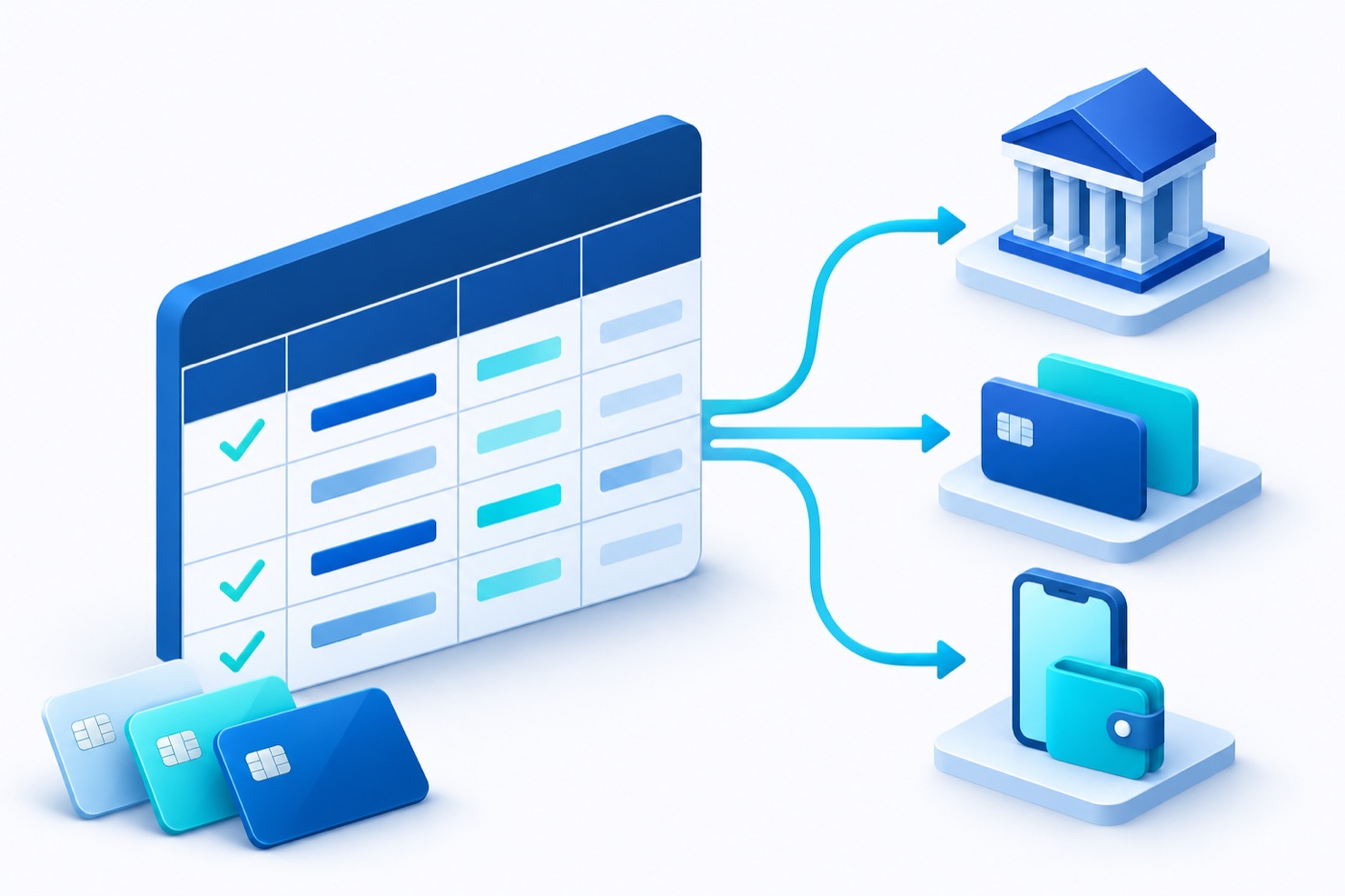
Score only what the vendor can evidence, then test the top two on real payments.
The priced pilot that replaces the demo
Ask the two finalists to process three real payments on your behalf: one small domestic payment, one mid-sized cross-border payment in a major currency, and one payment in your most difficult corridor. Provide the beneficiary details and let them quote, execute and settle.
Measure four things: the quoted amount versus the landed amount, the time from instruction to beneficiary credit, the quality of the status updates during the payment, and the data returned after settlement. That last one predicts your reconciliation effort for the next three years.
Run the same three payments through your current provider for comparison. The difference in landed cost is the only number that matters in the business case, and it is usually different from the difference in headline pricing.
Contract terms worth negotiating before price
Three clauses cause more post-signature pain than the fee schedule. The first is the unilateral pricing change clause: ask for a cap and an exit right if the increase exceeds it. The second is the corridor withdrawal clause: ask for 90 days' notice and transition assistance. The third is the data export clause: ask for a complete transaction history in a machine-readable format, at no charge, within 30 days of termination.
If the provider resists all three, the pricing conversation is less important than it looks. You are negotiating a relationship you cannot leave.
How Wondergate answers these questions
Wondergate's model is built around cross-border collection and payout for B2B platforms, with card issuing available through the same API. The corridor table distinguishes local-rail coverage from partner coverage, pricing is quoted per corridor with the FX source and timestamp, and settlement data is returned against your payment reference rather than a batch total. For teams that need a starting point on the technical evaluation, the B2B payment API integration checklist covers the sandbox tests and webhook behaviour to request. For the commercial comparison that follows the RFP, the B2B payment platform comparison sets out the cost tests, and the FX risk guide explains how to fix the rate convention in the contract.
A well-run RFP does not guarantee a good provider. It guarantees that you know what you are buying, what it will cost at your actual volumes, and what leaving would involve. That is usually enough to avoid the expensive mistake.