
The global cross-border B2B payments market is projected to reach $50 trillion by 2032. Yet the infrastructure moving that money — correspondent banking, SWIFT wires, multi-day settlement — still runs on a model designed in the 1970s. For CFOs and finance teams, the result is the same: 2–5% in hidden fees, 2–5 days of float, and zero visibility into where the money actually is.
Stablecoins — blockchain-based digital dollars that settle in seconds — are no longer just a crypto curiosity. In 2026, they are emerging as a practical settlement layer for B2B cross-border payments, connecting domestic instant-payment networks like Brazil's PIX, India's UPI, and Europe's SEPA Instant into a single, near-instant global grid.
This guide explains how stablecoins work for B2B payments, the "Stablecoin Sandwich" model, real adoption data, and what CFOs need to know before integrating them into their payment stack.
What Are Stablecoins — and Why Do They Matter for B2B?
A stablecoin is a digital token whose value is pegged to a fiat currency — typically the US dollar. Unlike Bitcoin or Ethereum, stablecoins do not fluctuate in value. USDC and USDT, the two largest, maintain a 1:1 peg to the dollar backed by reserves of cash and cash-equivalent assets.
For B2B payments, the key innovation is not the token itself. It is the settlement infrastructure that has grown around it. Stablecoins move on blockchain rails that settle in seconds, operate 24/7, and cost fractions of a cent per transaction — regardless of the amount.
The stablecoin market surpassed $220 billion in total circulation in 2025, and PYMNTS Intelligence data shows that 42% of middle-market companies have already discussed stablecoin adoption, though only 13% have implemented it to date. The gap between interest and adoption is closing fast.
The "Stablecoin Sandwich": How Cross-Border Settlement Actually Works
The most practical B2B model for stablecoin payments is not replacing existing payment infrastructure — it is inserting stablecoins between domestic systems. Industry insiders call this the "Stablecoin Sandwich."
The Architecture
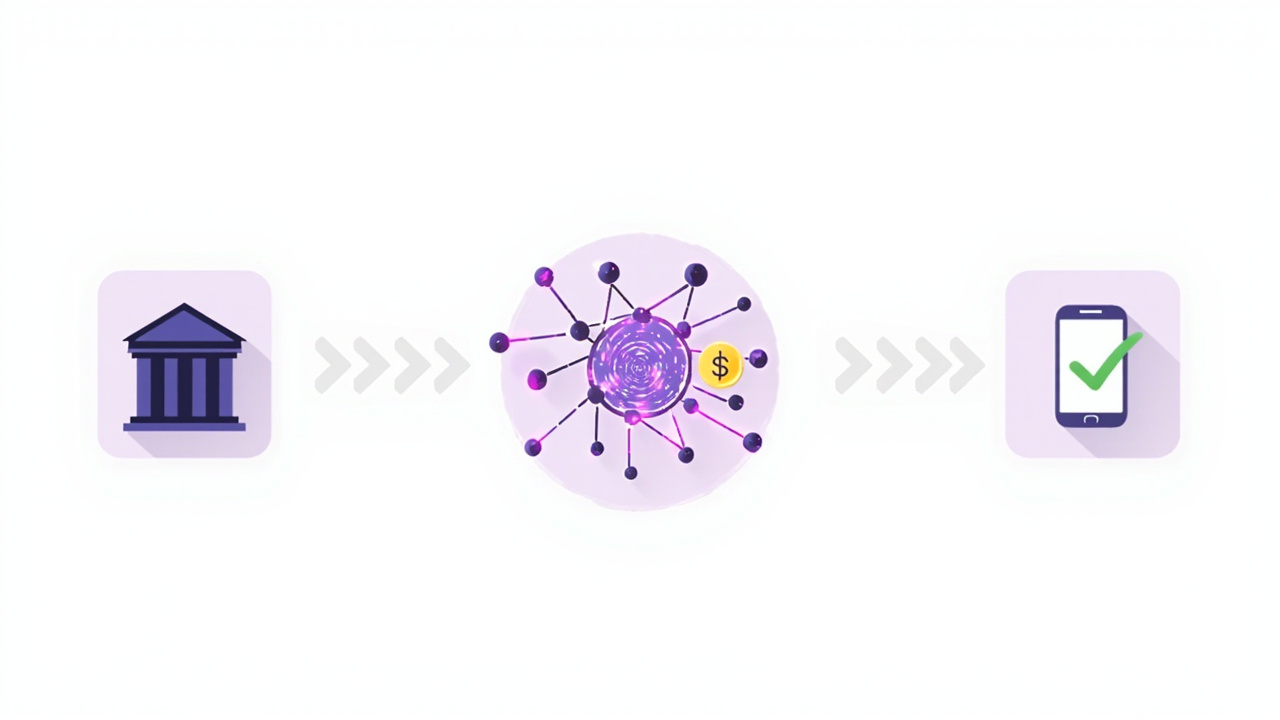
Instead of routing a payment through 2–4 correspondent banks across multiple jurisdictions, the Stablecoin Sandwich model works in three steps:
Step 1 — On-ramp (local → stablecoin): Funds move from the payer's bank account onto a stablecoin network. The payer sends USD from their US bank; the funds are converted to USDC on-chain.
Step 2 — Cross-border jump (stablecoin → stablecoin): The stablecoin travels across the blockchain to the recipient's wallet. This step takes seconds and costs under $0.01, regardless of whether the destination is Berlin, São Paulo, or Mumbai.
Step 3 — Off-ramp (stablecoin → local RTP): The stablecoin is converted into local currency and deposited into the recipient's account through the domestic instant-payment network — PIX in Brazil, UPI in India, SEPA Instant in Europe.
| Layer | Traditional SWIFT | Stablecoin Sandwich |
|---|---|---|
| Domestic leg | Bank A → Correspondent Bank 1 | Bank → Stablecoin on-ramp |
| Cross-border leg | CB1 → CB2 → CB3 → CB4 (serial) | On-chain transfer (seconds, <$0.01) |
| Receiving leg | CB4 → Beneficiary Bank → Beneficiary | Stablecoin off-ramp → Local RTP network |
| Total intermediaries | 2–4 correspondent banks | 0–2 (on/off-ramp providers) |
| Settlement time | 1–5 business days | Minutes to 1 hour |
| Total cost | $25–80 per payment | $2–15 per payment |
| Operating hours | Business hours, banking days only | 24/7/365 |
A Real Example
A US manufacturer pays a supplier in Brazil $50,000.
Traditional SWIFT path: USD → Correspondent Bank A (US) → Correspondent Bank B (intermediary) → Correspondent Bank C (Brazil) → Supplier's Bank → Supplier. Cost: ~$75 in wire fees + 2–3% FX spread = $1,075–$1,575 effective cost. Settlement: 2–4 business days.
Stablecoin Sandwich path: USD → USDC via on-ramp provider (seconds) → on-chain transfer (seconds, <$0.01) → off-ramp to BRL via PIX (minutes). Cost: ~$5–10 in on/off-ramp fees + ~0.5% FX spread = $255–260 effective cost. Settlement: under 1 hour.
That is a 75–83% cost reduction on a single transaction.
Who Is Actually Using Stablecoins for B2B in 2026?
Stablecoin adoption in B2B is no longer theoretical. Real infrastructure is being deployed:
Tetra Digital Group launched a Canadian-dollar stablecoin in May 2026 specifically designed to streamline cross-border B2B settlement between Canadian businesses and their international trading partners.
Visa and Mastercard have both integrated stablecoin settlement into their network infrastructure. Visa's USDC settlement pilot on Ethereum allows acquiring partners to settle transactions in stablecoins instead of fiat, compressing the settlement cycle from days to minutes.
Major payment orchestrators — including platforms that power B2B payments for enterprises — are adding stablecoin rails alongside traditional SWIFT, SEPA, and local-network pathways, giving CFOs the ability to route payments through the cheapest available rail in real time.
PYMNTS Intelligence's March 2026 report, "Stablecoins Gain Ground," found that among companies already using or testing stablecoins, the top three drivers were:
1. Faster settlement (cited by 67%)
2. Lower transaction costs (cited by 58%)
3. Access to markets with limited banking infrastructure (cited by 41%)
4 B2B Use Cases Where Stablecoins Deliver Immediate ROI
1. Cross-Border Supplier Payments
For businesses paying suppliers in emerging markets — Southeast Asia, Latin America, Africa — SWIFT corridors are often the most expensive and least reliable. Stablecoin rails bypass the correspondent banking chain entirely, delivering funds through local instant-payment networks at a fraction of the cost.
Best fit: Recurring supplier payments of $5,000–$500,000 to markets with limited banking infrastructure.
2. Multi-Entity Treasury Management
Corporations with subsidiaries in multiple jurisdictions face constant liquidity fragmentation — cash trapped in local accounts, expensive cross-border sweeps, and slow inter-entity settlements. Stablecoins enable same-day treasury sweeps across borders without correspondent banking markups.
Best fit: Companies with 3+ operating entities across different currency zones.
3. Cross-Border Payroll and Contractor Payments
Paying contractors in 10 countries means 10 different payment corridors, each with its own fee structure, FX markup, and settlement timeline. A stablecoin-based payroll solution consolidates these into a single settlement rail: bulk-fund a stablecoin wallet, distribute payments on-chain, and let recipients off-ramp into their local currency.
Best fit: Global teams, gig platforms, and companies with distributed contractor networks.
4. Marketplace and Platform Payouts
B2B marketplaces connecting buyers and sellers across borders need to split, hold, and disburse funds programmatically. Stablecoins' programmability — via smart contracts — enables automated split payments, escrow, and instant settlement that traditional banking rails cannot match.
Best fit: B2B marketplaces, procurement platforms, and supply-chain finance providers.
The Risks: What CFOs Need to Watch
Stablecoin adoption does not come without risk. Being conservative is the right posture.
Bridge Security
Stablecoins exist on multiple blockchains (USDC is on Ethereum, Solana, Polygon, Avalanche, and more). Moving value between chains requires a "bridge" — and bridge exploits represent nearly 40% of the entire value lost to crypto hacks across the industry's history. B2B users should work with regulated on/off-ramp providers that custody funds in segregated accounts and carry institutional-grade insurance, rather than interacting with DeFi bridges directly.
Regulatory Uncertainty
Not every jurisdiction welcomes stablecoins. Brazil banned eFX companies from using cryptocurrencies for remittance settlement in May 2026. The EU's MiCA framework provides a regulatory path, but US stablecoin legislation remains pending. Finance teams must track jurisdiction-specific rules and ensure their stablecoin providers hold appropriate licenses in each operating market.
Counterparty Risk
The stablecoin issuer must maintain a genuine 1:1 reserve. USDC (issued by Circle) publishes monthly attestations from a top-tier audit firm. Less transparent issuers carry de-pegging risk — the possibility that the stablecoin loses its dollar peg during market stress, as seen with USDC's brief de-peg to $0.87 during the Silicon Valley Bank crisis in 2023.
Liquidity Fragmentation
A USDC balance on Ethereum cannot be directly spent on a Solana-based payment rail. As new blockchains proliferate, stablecoin liquidity fragments across chains. CFOs need treasury infrastructure that aggregates balances across chains and provides a unified view of stablecoin positions.
| Risk | Severity | Mitigation |
|---|---|---|
| Bridge exploits | 🔴 High | Use regulated on/off-ramp providers; avoid direct DeFi bridge interaction |
| Regulatory bans | 🟡 Medium | Monitor jurisdiction-specific rules; choose licensed providers |
| Issuer de-pegging | 🟡 Medium | Choose transparent issuers (USDC) with regular reserve attestations |
| Liquidity fragmentation | 🟢 Low–Medium | Use treasury platforms with cross-chain aggregation |
| Operational complexity | 🟢 Low | Start with managed B2B payment platforms that abstract blockchain complexity |
How to Get Started with Stablecoin B2B Payments
For most businesses, the fastest path to stablecoin adoption is not building in-house — it is working with a B2B payment platform that has already integrated stablecoin rails.
A Practical 4-Step Implementation Plan
Step 1 — Audit your payment corridors. Identify the 3–5 corridors where you are paying the most in fees and experiencing the longest settlement times. These are your stablecoin pilot candidates.
Step 2 — Choose a regulated B2B payment provider. Look for providers that offer stablecoin settlement alongside traditional rails, hold appropriate licenses (MSB, EMI, or equivalent), and provide a dashboard — not a crypto wallet — for your finance team.
Step 3 — Run a controlled pilot. Select one supplier relationship or one payment corridor. Run 5–10 payments through the stablecoin rail and compare settlement time, total cost, and reconciliation effort against your existing SWIFT baseline.
Step 4 — Expand corridors and automate. Once the pilot proves the model, expand stablecoin routing to additional corridors and integrate it into your ERP or treasury management system via API.
Checklist: Is Your Business Ready for Stablecoin Payments?
- ✅ You process $100K+/month in cross-border payments
- ✅ You have at least one payment corridor with high fees or slow settlement
- ✅ Your finance team is comfortable with API-based payment workflows
- ✅ Your compliance team has reviewed stablecoin regulations in your operating jurisdictions
- ✅ Your payment provider or a partner offers regulated stablecoin on/off-ramp services
Common Misconceptions About Stablecoin B2B Payments
"Stablecoins are just crypto — too volatile for business."
Stablecoins are designed specifically to avoid volatility. USDC and USDT maintain 1:1 dollar pegs backed by reserves. They are payment instruments, not speculative assets. The volatility concern applies to Bitcoin and Ethereum — not to fiat-backed stablecoins.
"We need to hold crypto on our balance sheet."
No. Modern B2B payment platforms that integrate stablecoin rails handle the conversion automatically. Your finance team sees dollars in, dollars out — the stablecoin layer operates invisibly in the background, just like any other payment rail.
"Regulators will shut this down."
Regulation is evolving, not disappearing. The EU's MiCA framework provides a clear compliance path. Japan, Singapore, Hong Kong, and the UAE have all introduced stablecoin-specific regulatory frameworks. The direction of travel is toward regulation, not prohibition.
"Stablecoins are only for crypto-native companies."
The data disagrees. 42% of middle-market companies — traditional manufacturers, wholesalers, service providers — have discussed stablecoin adoption. The primary users in 2026 are not crypto exchanges; they are businesses moving money across borders.
📎 Related: Learn more about real-time settlement →
📎 Related: Learn more about regulatory landscape →
< >Related reading: Real-Time Cross-Border Payment Rails: 2026 Guide and DNS to RTGS: Cross-Border Wholesale Payments.
>Related reading: How to Reduce Cross-Border Payment Costs.
>Frequently Asked Questions
Q1: What are stablecoins and how are they used in B2B payments?
A: Stablecoins are cryptocurrencies pegged to fiat currencies (like USDC = $1 USD). In B2B payments, they enable near-instant cross-border settlement at a fraction of traditional banking costs, bypassing correspondent banking networks.
Q2: Are stablecoins safe for B2B cross-border payments?
A: Regulated stablecoins (USDC, EURe) with transparent reserves and regular audits are generally safe. Key risks include regulatory uncertainty, custody security, and counterparty risk. Always use regulated, fully-backed stablecoins from reputable issuers.
Q3: How much can stablecoins save on cross-border B2B payments?
A: Stablecoin transfers can reduce cross-border payment costs by 80-95% compared to traditional SWIFT wires. A $10,000 payment that costs $150-400 via SWIFT might cost $1-5 via stablecoins, with settlement in minutes instead of days.
📚 Further Reading
See also real-time payment rails, B2B payment innovation, global payments transformation, and cross-border payment costs.
>