B2B BNPL & Digital Trade Credit: The 2026 Guide for Global Businesses

Industry Insights|2026-08-03

Quick Answer: What Is B2B BNPL and Why Should Finance Leaders Care in 2026?

B2B BNPL (Buy Now, Pay Later) lets business buyers receive goods or services immediately while deferring payment — typically 30, 60, or 90 days — without the underwriting friction of traditional trade finance. Unlike consumer BNPL (Klarna, Afterpay), B2B BNPL is built for invoice-level transactions ranging from $5,000 to $500,000+, integrates with ERP and procurement systems, and handles the complexity of international tax, currency, and compliance requirements.

In 2026, B2B BNPL is transforming from a niche fintech experiment into a mainstream payment rail. 65% of B2B buyers now expect net terms at checkout, and digital-first suppliers are discovering that offering instant credit decisions — rather than waiting 2–4 weeks for traditional trade credit approval — directly impacts close rates and average order values. For finance leaders, B2B BNPL represents a strategic lever: it accelerates cash conversion for suppliers while giving buyers the working capital flexibility they need in an era of tight credit markets.

What Is B2B BNPL and How Does It Differ from Consumer BNPL?

At its core, B2B BNPL is a digital trade credit facility embedded at the point of purchase. When a business buyer selects "pay by invoice" or "net 30 terms" at checkout, a B2B BNPL provider performs real-time credit underwriting — often within seconds — and funds the supplier immediately while collecting from the buyer on agreed terms. But the comparison to consumer BNPL ends at the concept level. B2B BNPL operates in a fundamentally different environment:

Transaction Size and Complexity. Consumer BNPL averages $100–$300 per transaction. B2B BNPL routinely handles five- and six-figure invoices, often involving cross-border currency, multi-line-item purchase orders, partial shipments, and milestone-based payments. The underwriting model must assess business creditworthiness, not just individual FICO scores.

Integration Depth. Consumer BNPL lives at the e-commerce checkout page. B2B BNPL must integrate with ERP systems (SAP, NetSuite, Microsoft Dynamics), procurement platforms (Coupa, Ariba), AP automation tools, and bank reconciliation workflows. A BNPL transaction that doesn't flow into the buyer's AP system creates more work than it saves.

Regulatory and Compliance Layer. Cross-border B2B transactions trigger KYC/KYB (Know Your Business) requirements, sanctions screening, trade compliance checks, and tax documentation that consumer BNPL never encounters. A B2B BNPL provider must be a compliance partner, not just a credit provider.

Payment Terms and Structures. Consumer BNPL is usually 4 interest-free installments over 6 weeks. B2B BNPL offers net-30, net-60, net-90 terms, installment plans spanning 12–24 months for large capital purchases, and dynamic discounting (early payment discounts that adjust based on when payment is made).

Why B2B Companies Are Adopting Digital Trade Credit Now

The acceleration of B2B BNPL adoption in 2025–2026 isn't a coincidence — it's the convergence of three structural shifts:

1. The B2C Experience Has Rewired Buyer Expectations. Procurement managers and finance teams now use BNPL, instant payments, and digital wallets in their personal lives. When their B2B purchasing experience involves paper credit applications, 2-week approval cycles, and manual bank transfers, the disconnect is palpable. B2B BNPL closes this experience gap.

2. Tightening Credit Markets Are Squeezing SMB Buyers. Traditional bank credit lines for small and mid-market businesses have contracted in many regions. B2B BNPL providers — using alternative data, real-time cash flow analysis, and AI underwriting — are extending credit to creditworthy businesses that banks have overlooked, growing the addressable market for suppliers.

3. Suppliers Are Competing on Payment Terms. In industries where product differentiation is hard, payment terms have become a competitive weapon. A supplier offering "net-60, instant approval" at checkout converts at higher rates than one requiring a manual credit application. B2B BNPL lets suppliers offer generous terms without taking balance sheet risk — the BNPL provider funds the supplier immediately and assumes the credit risk.

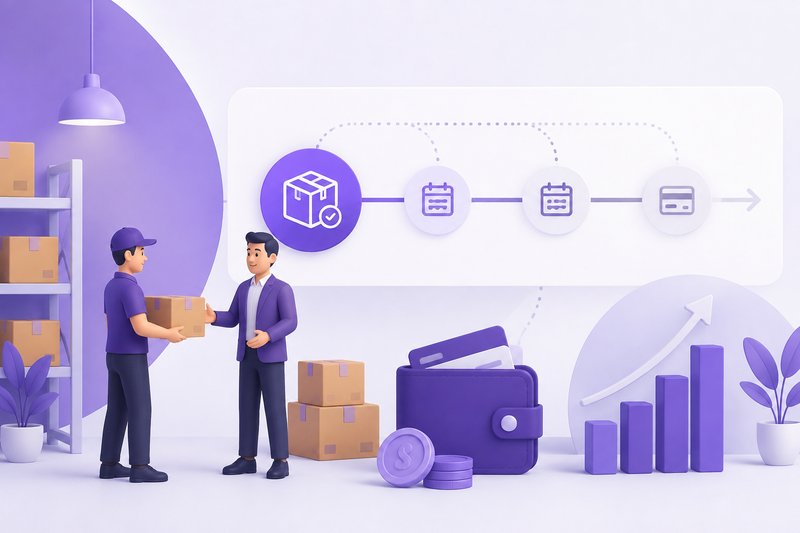
How B2B BNPL Works: The Transaction Flow

Understanding the mechanics is essential for evaluating providers. Here's the end-to-end flow of a typical B2B BNPL transaction:

Step 1 — Checkout Integration. At the supplier's online checkout, invoice portal, or sales-quote workflow, the buyer selects "Pay by Invoice" or "Net-30 Terms." The BNPL widget (embedded via API or hosted page) captures basic business information: company name, registration number, billing address, and PO number.

Step 2 — Real-Time Underwriting. The BNPL provider's engine pulls business credit data (Dun & Bradstreet, Experian Business, Creditsafe), bank transaction data (via open banking APIs), trade references, and in some cases real-time accounting data (via QuickBooks/Xero integration). An AI model assesses credit risk and returns a decision — typically in under 30 seconds — along with the approved credit limit and terms.

Step 3 — Instant Funding to Supplier. Upon approval, the BNPL provider immediately remits the full invoice amount to the supplier (minus the BNPL fee). The supplier recognizes revenue and ships the order — no waiting for buyer payment.

Step 4 — Buyer Payment Collection. The BNPL provider manages the entire receivables lifecycle: sending invoices, payment reminders, and collecting payment via bank transfer, ACH, virtual card, or direct debit. The buyer pays on the agreed terms (net-30, net-60, etc.).

Step 5 — Reconciliation and Reporting. Both supplier and buyer receive automated reconciliation reports. The supplier's ERP records the payment against the invoice. The buyer's AP system tracks the BNPL liability. Most providers offer dashboards showing outstanding balances, payment schedules, and credit utilization.

B2B BNPL vs Traditional Trade Finance: A Practical Comparison

Dimension B2B BNPL Traditional Trade Credit
Credit Decision Time Seconds to minutes 2 days to 4 weeks
Integration API-first, embeds in checkout/ERP Manual forms, email, PDF
Underwriting Data Multi-source: bank data, accounting, trade refs, AI scoring Financial statements, bank references, trade references
Transaction Range $1K–$500K+ $10K–$10M+
Cross-Border Capability Built-in: multi-currency, compliance screening Requires trade finance bank + LC/SBLC
Supplier Risk Zero — BNPL provider funds immediately Supplier carries credit risk until buyer pays
Buyer Cost 1.5%–4% of invoice (flat or tiered) Interest on credit line (prime + spread)
Setup Time API integration: days to weeks Bank relationship: months

Note: B2B BNPL excels at speed and accessibility for mid-market transactions; traditional trade finance remains superior for very large, complex, or project-finance deals requiring letters of credit and multi-party structures.

Key Players in the B2B BNPL Ecosystem (2026)

The B2B BNPL landscape has matured into distinct categories. Understanding these helps buyers identify the right fit:

1. Embedded BNPL Providers. Companies like Mondu, Hokodo, Tranch, and Two provide white-label or API-based BNPL that sits inside a supplier's existing checkout or invoicing flow. They handle underwriting and collections but remain invisible to the end buyer — who sees the supplier's brand, not the BNPL provider. Best for: digital-first B2B merchants and marketplaces.

2. Payment Platform BNPL. Full-stack B2B payment platforms (Billie, Melio, Plastiq) increasingly offer embedded trade credit as a feature alongside AP/AR automation and payment processing. The advantage is unified workflow: the buyer manages all payables — including BNPL obligations — in one dashboard. Best for: mid-market businesses wanting payment operations consolidation.

3. Bank-Linked Digital Trade Finance. Traditional banks (HSBC, Standard Chartered, J.P. Morgan) are launching digital trade credit products that compete with fintech BNPL while leveraging existing corporate banking relationships and regulatory infrastructure. Best for: large enterprises with existing bank relationships who want digital convenience without switching providers.

4. Marketplace and Procurement-Integrated BNPL. Platforms like Amazon Business (via partner integrations), Alibaba.com (Trade Assurance), and vertical B2B marketplaces embed BNPL directly into their procurement flows. Credit decisions are based on platform transaction history. Best for: businesses buying primarily through B2B marketplaces.

Integration: Connecting B2B BNPL with Your Existing Systems

B2B BNPL's value proposition collapses if it creates manual work for finance teams. The integration layer is what separates enterprise-ready providers from consumer-grade experiments:

ERP Integration. The BNPL provider must push transaction data into your general ledger automatically — not via CSV export. Look for pre-built connectors to SAP Business One, NetSuite, Microsoft Dynamics 365, and Acumatica. The integration should map BNPL transactions to the correct GL accounts (BNPL liability for buyers, BNPL fee expense for suppliers) without manual journal entries.

AP Automation. For buyers, the BNPL provider should integrate with AP platforms like Bill.com, Tipalti, or Airbase so that BNPL obligations appear alongside other payables in the approval and payment workflow. The last thing a finance team needs is a separate login to track BNPL payments.

Procurement System Integration. If your company uses Coupa, Ariba, or Procurify, the BNPL option should be selectable within the procurement workflow — ideally with pre-approved credit limits visible to buyers before they begin the purchase order process. This eliminates the common pain point of selecting a supplier, building a PO, and then discovering the payment terms don't work.

Reconciliation Automation. The BNPL provider should support automated three-way matching (PO, invoice, payment) via API or EDI. For suppliers, this means the BNPL provider's remittance data feeds directly into your AR reconciliation process.

Risk Management: Credit, Fraud, and Compliance in B2B BNPL

B2B BNPL shifts credit risk from the supplier to the BNPL provider — but that doesn't mean risk disappears. Finance leaders evaluating BNPL must understand the risk architecture:

Credit Risk. B2B BNPL providers use multi-layered underwriting models. Beyond traditional credit bureau data, they analyze real-time bank transaction patterns, accounting data (via open banking), trade payment history, and industry-specific risk factors. The best providers combine AI models with human underwriters for larger transactions and use dynamic credit limits that adjust based on repayment behavior.

Fraud Prevention. Business identity fraud — where a fraudster impersonates a legitimate business to obtain credit — is the primary fraud vector in B2B BNPL. Robust KYB (Know Your Business) verification — including beneficial ownership verification, business registration cross-checking, and director identity verification — is non-negotiable. Ask providers about their KYB stack and fraud loss rates before committing.

Settlement and Counterparty Risk. Unlike consumer BNPL, where the buyer is an individual, B2B BNPL involves corporate entities that can become insolvent. Understand the provider's provisioning for bad debt, their recourse model (recourse vs non-recourse to supplier), and what happens in a buyer default scenario.

Cross-Border Compliance. For international transactions, the BNPL provider must handle sanctions screening (OFAC, EU, UN), anti-money laundering (AML) checks, and country-specific trade compliance requirements. This is not optional — suppliers can face legal exposure if their BNPL provider cuts corners on compliance.

Costs and Fee Structures: What B2B BNPL Actually Costs

B2B BNPL pricing is less standardized than consumer BNPL, and fee structures vary significantly by provider. Here's what to expect in 2026:

Fee Type Typical Range Who Pays
Transaction Fee 1.5%–4.0% of invoice value Typically supplier (can be split)
Late Payment Fee 1%–3% per month on overdue balance Buyer
Cross-Border FX Markup 0.5%–2.0% above mid-market Embedded in transaction fee
Platform/Integration Fee $0–$5,000/month (enterprise plans) Supplier
Early Repayment Discount Varies — dynamic discounting model Optional buyer incentive

Supplier economics: If your gross margin is 30% and BNPL costs 3%, you're spending 10% of your margin on credit facilitation. Run the numbers against the expected uplift in conversion rate and average order value before committing to a provider.

5 Questions to Ask Before Choosing a B2B BNPL Provider

Not all B2B BNPL is created equal. Use these five questions to cut through sales pitches and evaluate providers on operational readiness:

1. "What does your underwriting approval rate look like for my typical buyer profile?" A provider with a 95% approval rate that only approves transactions under $5,000 is useless if your average invoice is $25,000. Demand segment-specific data: approval rates by transaction size, industry, and geography.

2. "Show me your ERP integration — not the sales demo, the actual API documentation." If the integration involves manual CSV uploads or requires your finance team to log into a separate portal, walk away. The provider should demonstrate bi-directional, real-time data flow with your specific ERP.

3. "What is your bad debt rate and how do you handle disputed transactions?" A low bad debt rate might indicate overly conservative underwriting (poor buyer experience). A high rate signals weak risk management. Also clarify the dispute resolution process: if a buyer disputes quality or delivery, who bears the financial risk during resolution?

4. "How do you handle cross-border compliance for the countries I sell into?" Don't accept "we're compliant globally" as an answer. Ask for the specific jurisdictions covered, the sanctions screening provider they use, and whether their KYB process meets the requirements of your most demanding regulatory markets.

5. "What happens when a buyer doesn't pay — walk me through the exact process?" Understand the dunning (collections) process, the timeline from missed payment to escalation, and whether the provider uses internal collectors or third-party agencies. The collections experience reflects on your brand, even if the BNPL provider is technically the creditor.

Common Pitfalls When Implementing B2B BNPL

Even well-chosen BNPL implementations can stumble. Avoid these patterns observed across 2024–2026 deployments:

Pitfall 1: Adding BNPL without updating sales processes. If your sales team doesn't proactively present BNPL as a payment option during negotiations, adoption will flatline. BNPL isn't a "set it and forget it" checkout widget — it's a sales enablement tool. Train your team to use "we can offer you instant net-60 terms" as a closing lever.

Pitfall 2: Treating BNPL as a checkout-only feature. Many B2B purchases happen via sales quotes, procurement portals, and invoicing — not just e-commerce checkout. If your BNPL integration only covers the website cart, you're missing 60–80% of B2B transaction volume. Ensure BNPL is available across all purchase channels.

Pitfall 3: Underestimating reconciliation complexity. BNPL adds a third party between you and your customer. When a BNPL provider remits payment, your AR team needs to match that payment to the original invoice — and the reference numbers, amounts, and timing rarely line up perfectly without automation. Invest in reconciliation integration before scaling BNPL volume.

Pitfall 4: Ignoring buyer-side experience. A BNPL implementation optimized for supplier convenience but confusing for buyers will drive customers away. The buyer should see clear payment schedules, receive automated reminders, and have a self-service portal to manage payments. If your buyer's AP team hates the experience, they'll pressure procurement to find another supplier.

The Future: Embedded Trade Credit and AI-Powered Underwriting

B2B BNPL in 2026 is a stepping stone to something larger: the complete digitization of B2B trade credit. Several trends are accelerating this transformation:

Embedded Trade Credit Becomes Infrastructure. Just as payment processing became a utility (Stripe, Adyen), trade credit is following the same path. Platforms that connect buyers and suppliers — B2B marketplaces, procurement networks, industry-specific exchanges — will embed trade credit as a default feature, not an add-on. The BNPL provider becomes invisible infrastructure.

AI Underwriting Moves from "Better Than Banks" to "Fundamentally Different." Current B2B BNPL underwriting improves on traditional credit assessment by using more data sources. The next generation — powered by large language models analyzing unstructured data like news sentiment, supply chain relationships, and industry trends — will make credit decisions that traditional underwriters cannot replicate. Real-time cash flow analysis, predictive insolvency models, and continuous credit monitoring will replace periodic credit reviews.

Dynamic Terms Replace Fixed Terms. Instead of static net-30 or net-60 terms, AI-driven BNPL will offer dynamic terms: "Pay in 23 days for a 1.2% discount, or 47 days at standard rate" — optimized in real-time based on the buyer's cash position, the supplier's working capital needs, and market interest rates. This is fundamentally more efficient than one-size-fits-all credit terms.

BNPL + Supply Chain Finance Convergence. The line between BNPL and supply chain finance is blurring. Platforms are emerging that offer a spectrum of credit products — from instant checkout BNPL for small purchases to approved payables finance for recurring supplier relationships — all managed through a single credit facility and dashboard.

Frequently Asked Questions

Is B2B BNPL the same as supply chain finance?
No, though they're converging. Supply chain finance (reverse factoring) is typically initiated by the buyer and covers approved invoices from established suppliers. B2B BNPL is initiated at the point of purchase and can cover first-time buyers, new supplier relationships, and smaller transactions that wouldn't justify traditional supply chain finance setup.

Do I need to offer BNPL as a supplier if my competitors do?
Increasingly, yes — especially in competitive B2B verticals like wholesale, industrial supplies, and technology distribution. BNPL is becoming table stakes in the same way that "accepts credit cards" became non-negotiable for B2C e-commerce 15 years ago. However, the decision should be driven by data: test BNPL on a segment of customers and measure the impact on conversion rate, average order value, and customer acquisition cost before rolling out broadly.

What's the minimum transaction size for B2B BNPL to make economic sense?
Most providers have a minimum transaction threshold of $500–$1,000. Below this, the fixed costs of underwriting and compliance outweigh the fee revenue. For very small B2B transactions, traditional payment methods (credit card, ACH) remain more economical. The B2B BNPL sweet spot is $5,000–$100,000.

Can B2B BNPL work for international cross-border transactions?
Yes — and cross-border is actually where B2B BNPL adds the most value. International B2B transactions face longer payment cycles, higher credit risk uncertainty, and more complex compliance requirements than domestic transactions. A BNPL provider that handles multi-currency settlement, FX, and cross-border KYB/KYC can significantly reduce friction. However, verify country coverage carefully: many providers are strong in US/UK/Europe but have limited coverage in Asia, Africa, and Latin America.

How do BNPL providers protect against buyer non-payment?
Providers combine pre-transaction underwriting (credit assessment, KYB verification, fraud screening) with post-transaction monitoring (payment behavior tracking, credit limit adjustments) and collections processes. Most providers retain the credit risk themselves (non-recourse to supplier), meaning if the buyer defaults, the supplier keeps the funds. However, some providers offer recourse models at lower fees — understand which model you're signing up for.

Ready to streamline your cross-border payments?

Discover how Wondergate can help your business scale globally.